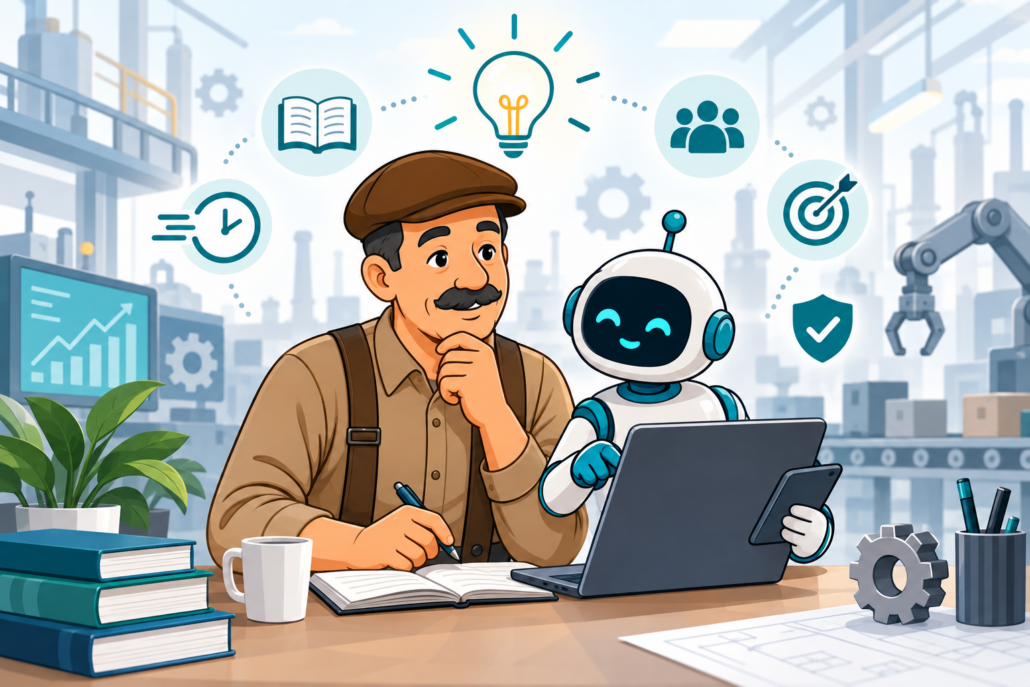
Mr. Bucket and AI – What Can an Old Story Teach Us in the Age of Artificial Intelligence?
One of the less-discussed subplots in Tim Burton’s 2005 film Charlie and the Chocolate Factory follows Charlie’s father, Mr. Bucket. He works in a factory, performing the same repetitive task day after day. Then machines are introduced, his job is automated, and he loses his position.
But the story does not end there. Later, he returns to the same factory, this time to maintain and supervise the very machines that had previously taken over his job.
Over the past few weeks, we have used Mr. Bucket’s story as a starting point on Dynago’s LinkedIn page to explore several questions around the everyday use of AI.
How is artificial intelligence reshaping our day-to-day work? Which skills are becoming more important, and what remains the real role of the employee?
Adaptation
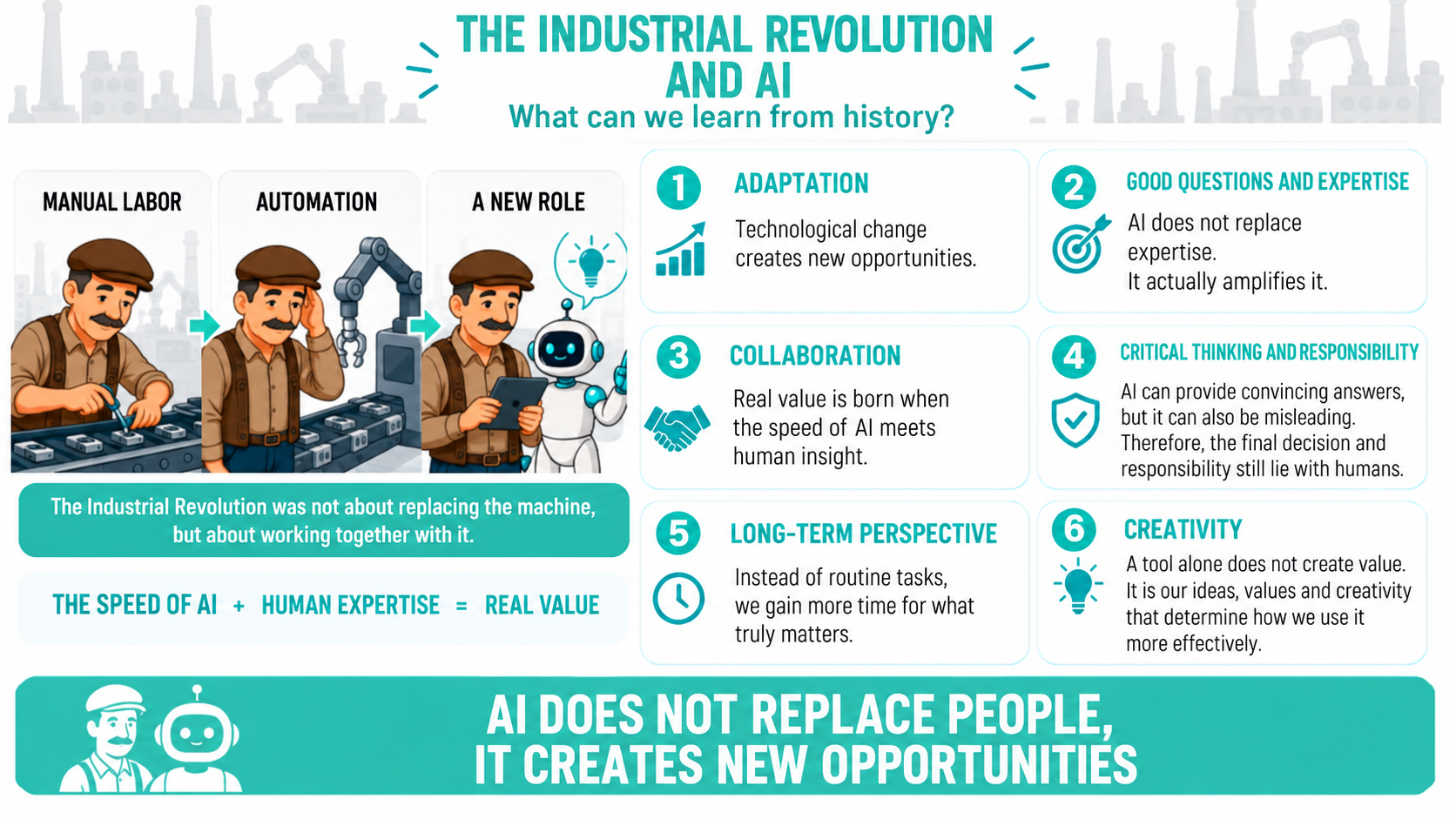
The first lesson in Mr. Bucket’s story is adaptation. Technological progress eliminated his previous role, but at the same time created a new opportunity for him. Taking it required new knowledge, new responsibilities, and a different way of thinking.
A similar process can be seen in the rise of artificial intelligence. Many tasks that once required a significant amount of manual work can now be partially or fully automated.
An AI assistant can summarize lengthy documents, process large volumes of information quickly, highlight the most relevant points, or even outline several possible solutions.
This does not necessarily mean that the human role is diminishing; rather, it is changing. By automating routine tasks, more time and attention can be devoted to activities that require human experience, professional judgment, creativity, and responsible decision-making.
AI creates real value when the speed of technology meets human experience and expertise.
The Role of Good Questions and Expertise
In his new role, Mr. Bucket had to learn how the machines he worked with actually functioned. The same is true of artificial intelligence.
Today, AI can provide a starting point for solving a professional problem in a matter of seconds. The quality of the outcome, however, depends on how we use it. The deeper our knowledge of a given field, the more precisely we can ask questions, the more easily we can spot potential errors, and the more confidently we can judge which suggestions are applicable in practice.
AI therefore does not make expertise redundant. In many cases, quite the opposite: it increases its value and importance even further.
Collaboration, Not Replacement
Mr. Bucket’s story also shows that technological change is not necessarily a choice between people and machines. When he returns to the factory, he no longer works instead of the machines, but alongside them: operating, supervising, and maintaining them.
This kind of collaboration can also be one of the most important principles when using artificial intelligence.
An AI assistant can organize information, summarize documents, or prepare background materials to support decision-making. The decisions themselves, however, are still made by people.
Real value is often created where the speed of AI meets human experience. Technology can help us reach the heart of a problem more quickly, but setting priorities and taking responsibility remain firmly in human hands.
A Confident Answer Is Not Necessarily a Good Answer
AI can produce answers that sound convincing while still being inaccurate or simply wrong.
Responsible use therefore includes checking information and comparing it against other sources. The people who use AI most effectively are neither those who automatically accept every answer nor those who reject it outright. The real advantage may go to those who learn to work with it while retaining their professional knowledge, sound judgment, and critical thinking.
Giving Time Back
One of the most visible benefits of artificial intelligence is that it can help us complete certain tasks faster and more efficiently. The more interesting question, however, is what we do with the time this frees up.
If less energy has to be spent on administrative and routine tasks, more time can be devoted to clients, gaining a deeper understanding of business challenges, developing new ideas, or learning.
The real value of AI may therefore lie not in squeezing more tasks into the same working day, but in giving us back time for what truly matters.
No Progress Without Curiosity
Behind all of this lies another important quality: curiosity. A new tool does not create value on its own. Value emerges when someone tries it, asks questions, experiments, and learns how to use it effectively in their own work.
Mr. Bucket’s story is therefore not only about technology, but also about how we adapt to change. AI is a new tool, a new way of working, and in some situations it can even become a digital colleague. The question is no longer whether it will become part of everyday work, but how we learn to use it in a way that creates real value.
At Dynago, we work to turn the opportunities offered by artificial intelligence into practical solutions that create real value in everyday business processes.
If you are interested in practical applications of AI, follow Dynago’s LinkedIn page and blog. If you are looking for ways to apply AI in your own business processes, get in touch with our experts.